
TL;DR:
- Incrementality testing measures the true impact of advertising by comparing conversion rates between an exposed group and a control group that sees no ads. Most marketing teams should run these tests for 3–6 weeks, using proper suppression methods and updating multipliers quarterly to ensure accuracy. Combining incrementality testing with other measurement methods provides the most reliable insight into advertising effectiveness.
Incrementality testing is a controlled marketing experiment that measures which conversions actually result from your ad campaigns by comparing an exposed group against a holdout group that receives no ads. Over half of US brand and agency marketers now use this method to separate net-new conversions from organic activity. The core problem it solves is attribution’s fundamental flaw: last-click and multi-touch models credit ads for conversions that would have happened anyway. Studies show that 50–80% of branded paid search conversions would have occurred without any ad exposure at all. That number alone explains why causal impact analysis has moved from academic experiment to standard practice for serious marketing teams.
What is incrementality testing and how does it work?
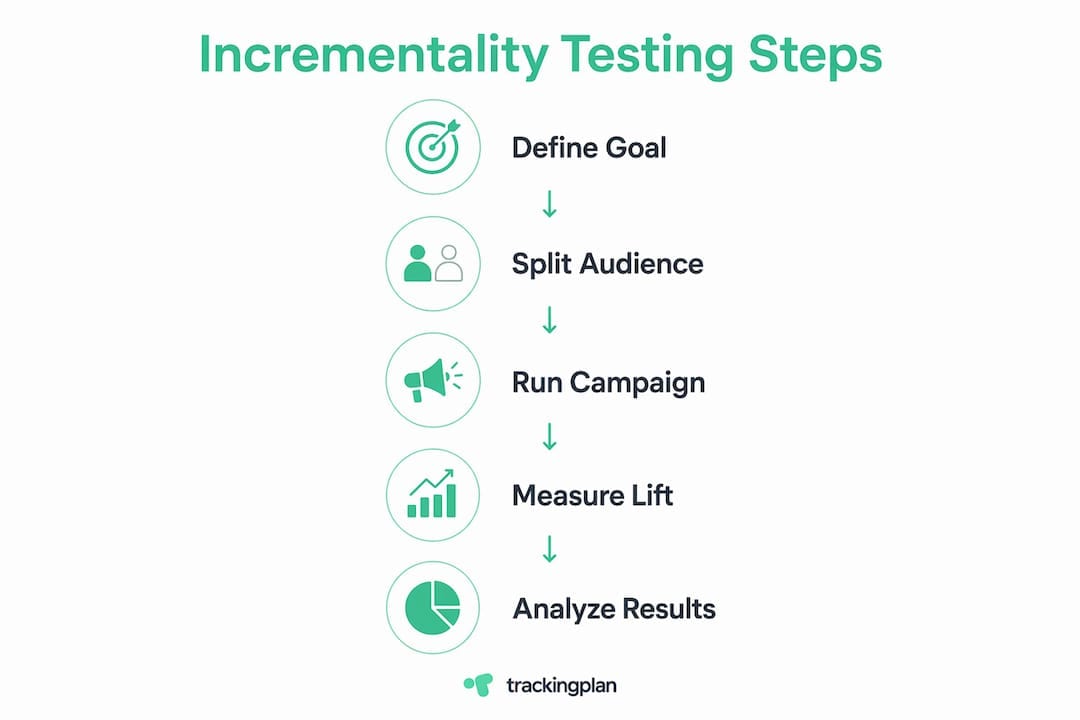
Incrementality testing works by randomly splitting your audience into two groups. The treatment group sees your ads as normal. The holdout group, also called the control group, is suppressed from seeing those ads entirely. After the test period ends, you compare conversion rates between the two groups. The difference is your incremental lift: the conversions that genuinely resulted from the campaign.

Effective incrementality tests run for 3–6 weeks and expose less than 10% of your total market to the holdout condition. That window is long enough to capture meaningful purchase cycles without distorting your revenue baseline. Shorter tests miss delayed conversions; longer tests introduce seasonal noise that corrupts the signal.
Three main experimental designs are used in practice:
- Randomized holdouts: Audience members are randomly assigned to treatment or control at the user level. This works well for digital channels where you control ad delivery at the individual level.
- Geo-split tests: Geographic regions serve as the unit of randomization. One set of cities or regions runs the campaign; a matched set does not. This approach suits channels like TV, out-of-home, or direct mail where user-level suppression is not possible.
- Synthetic controls: A statistical method that constructs a “counterfactual” market by weighting similar regions or time periods. This is useful when you cannot run a clean holdout due to operational constraints.
Statistical significance is non-negotiable. Underpowered tests produce unreliable lift estimates that lead to bad budget decisions. Before launching, calculate the minimum detectable effect based on your baseline conversion rate and expected audience size. Most teams underestimate how large a sample they need to detect a 5–10% lift reliably.
Pro Tip: Use server-side suppression rather than client-side ad blocking to prevent holdout group members from accidentally seeing your ads through retargeting pools or lookalike audiences. This is the most common source of leakage in basic test setups.
How does incrementality testing compare to other measurement methods?
The distinction between incrementality testing and attribution is not just technical. It is the difference between correlation and causation. Attribution models assign credit to touchpoints based on observed paths to conversion. Incrementality testing isolates true causal impact by asking a fundamentally different question: would this conversion have happened without the ad?
A/B testing and incrementality testing are often confused, but they serve different purposes. A/B testing compares two creative variants or landing pages to find which performs better within an exposed audience. Incrementality testing compares an exposed audience against a non-exposed audience to determine whether advertising itself drives additional conversions. The scope and objective are entirely different.
Marketing Mix Modeling (MMM) operates at a higher level, using historical spend and sales data to estimate channel contributions across long time horizons. MMM is powerful for strategic planning but relies on statistical inference rather than controlled experiments. Incrementality results can anchor MMM as Bayesian priors, giving the model causal ground truth that prevents common artifacts like over-crediting high-spend channels.
| Method | Question answered | Causal? | Time horizon | Best use |
|---|---|---|---|---|
| Last-click attribution | Which touchpoint preceded conversion? | No | Real-time | Tactical reporting |
| A/B testing | Which variant performs better? | Partial | Days to weeks | Creative and UX optimization |
| Marketing Mix Modeling | How does spend affect sales over time? | Partial | Months to years | Budget planning |
| Incrementality testing | Did this ad cause additional conversions? | Yes | Weeks | Channel validation and spend decisions |
The most effective measurement programs use all three in combination. Incrementality testing provides the causal ground truth. MMM provides the long-term view. Platform attribution provides the operational signal. Relying on any single method alone produces a distorted picture of advertising effectiveness.
What are the biggest challenges in incrementality testing?
Leakage is the most common and most damaging problem in incrementality testing. Leakage occurs when control group members are exposed to the ads they were supposed to be suppressed from seeing. Advanced teams prevent leakage through server-side suppression and IP-based geo-fencing rather than relying on platform-level audience exclusions, which are imperfect. Even small amounts of leakage can compress your measured lift and make an effective campaign appear flat.

The second major challenge is the revenue trade-off of running holdouts. Withholding ads from a portion of your audience has a real short-term cost. Running holdouts in limited geographies or small audience segments keeps that cost manageable while still generating statistically valid results. The goal is to make the cost of learning smaller than the value of the optimization decision it enables.
A third challenge is the assumption that incrementality is static. It is not. Incrementality varies by channel, audience, and campaign type, and lift factors shift with seasonal dynamics and market conditions. Teams that apply a single company-wide incrementality multiplier across all channels and all quarters will systematically misallocate budget.
Common pitfalls to avoid:
- Using holdout groups larger than 10% of your audience. The revenue cost grows faster than the statistical benefit beyond this threshold.
- Running tests during atypical periods. Holiday weeks, product launches, and promotional events distort baseline conversion rates and make lift estimates unreliable.
- Applying one multiplier across all channels. Paid social, paid search, and display each have different incremental lift profiles that change over time.
- Ignoring halo effects. Nielsen research confirms that campaigns reaching 40% or more of their intended audience generate 1.3–1.6x greater lift on both featured and adjacent products. Measuring only direct conversions understates total incremental value.
Pro Tip: Update your incrementality multipliers at least quarterly, broken out by channel and audience segment. A multiplier calibrated in Q1 will be wrong by Q4 if market conditions have shifted.
How to implement an incrementality testing program
A structured approach to implementation prevents the most common errors and produces results you can actually act on.
-
Start with your highest-spend channels. Paid search and paid social typically represent the largest share of budget and carry the highest risk of over-attribution. These channels also have the infrastructure to support user-level holdout suppression, making them the easiest starting point.
-
Choose the right methodology for each channel. Digital channels support randomized holdouts. Offline channels like TV or direct mail require geo-split tests or synthetic controls. Match the method to the channel’s technical constraints, not to your preference.
-
Set test duration based on your purchase cycle. A 3-week test works for fast-moving consumer goods with short consideration windows. A 6-week test is the minimum for categories with longer purchase cycles, such as financial products or B2B software. The lift testing implementation guide from Trackingplan covers duration planning in detail.
-
Size your holdout group correctly. Keep it below 10% of your total audience or market. Calculate the minimum sample size needed to detect your expected lift at 95% confidence before you start. Do not adjust the holdout size mid-test.
-
Interpret results in context. A positive incremental lift confirms the channel drives net-new conversions. A lift near zero means the channel is capturing conversions that would have happened organically. Negative lift is rare but signals that your ads may be disrupting the natural purchase path.
-
Apply correction coefficients to your attribution data. Once you have a measured lift factor, apply it as a multiplier to your platform-reported conversions. This gives you a corrected conversion count that reflects actual causal impact rather than attributed credit. Proper campaign tracking accuracy is a prerequisite for this step to work reliably.
-
Build a testing calendar. Run tests across channels on a rotating schedule so you always have fresh multipliers. Avoid overlapping tests on the same audience segment simultaneously, as this creates interference that corrupts both results.
The goal of an ongoing program is not to run one test and declare victory. Measurement leaders recommend anchoring incrementality results with MMM and platform data to build a unified measurement system that improves over time. Proper audience segmentation is also critical when designing treatment and control groups to avoid confounding variables.
Key Takeaways
Incrementality testing is the only measurement method that proves causal lift, and combining it with MMM and updated channel multipliers produces the most accurate picture of advertising effectiveness.
| Point | Details |
|---|---|
| Causal proof over correlation | Incrementality testing isolates conversions caused by ads, not just correlated with them. |
| Holdout size matters | Keep control groups below 10% of your audience to balance learning value against revenue cost. |
| Update multipliers quarterly | Lift factors shift by channel and season; static multipliers lead to budget misallocation. |
| Combine with MMM | Use incrementality results as Bayesian priors to anchor and improve Marketing Mix Models. |
| Leakage kills accuracy | Server-side suppression and geo-fencing are required to prevent control group contamination. |
Why I think most teams are running incrementality tests wrong
Most marketing teams treat incrementality testing as a one-time validation exercise. They run a test, confirm their paid social channel has positive lift, and move on. That is the wrong mental model entirely.
The real value of incrementality measurement is not the single test result. It is the system you build around it. Lift factors decay. Market conditions shift. A channel that showed strong incremental lift in Q1 may be capturing mostly organic conversions by Q3 because your brand awareness has grown. If you are not updating your multipliers, you are making budget decisions with stale data.
The second mistake I see consistently is treating incrementality as a replacement for other measurement methods. It is not. Incrementality gives you causal ground truth at a point in time. MMM gives you the long-term view across channels. Platform attribution gives you the operational signal for day-to-day decisions. You need all three. Teams that abandon MMM because they now run holdout tests are trading one blind spot for another.
The third mistake is underinvesting in data quality before running tests. A holdout test built on broken tracking data produces a broken lift estimate. If your pixels are misfiring, your conversion counts are wrong, and your measured lift is fiction. The foundation of any valid incrementality program is clean, verified tracking data. That is not optional. Analytics in marketing consistently shows that data quality is the variable most teams underestimate when designing measurement programs.
— David
How Trackingplan helps you run valid incrementality tests
Reliable incrementality results depend entirely on clean tracking data. If your conversion pixels are misfiring or your event schemas are inconsistent, your holdout comparison is built on a flawed baseline.

Trackingplan monitors your digital analytics implementations in real time, catching broken pixels, schema mismatches, and campaign misconfigurations before they corrupt your test data. Its AI-powered alerts notify your team via Slack, email, or Teams the moment an anomaly appears, so you can fix tracking errors before they run for days undetected. For teams running geo-split or holdout tests, Trackingplan’s web tracking monitoring gives you continuous visibility into whether your measurement infrastructure is functioning correctly across all markets and audience segments.
FAQ
What is incrementality testing in marketing?
Incrementality testing is a controlled experiment that measures how many conversions were directly caused by an ad campaign by comparing an exposed group against a holdout group that saw no ads. The difference in conversion rates between the two groups is the incremental lift.
How long should an incrementality test run?
Most incrementality tests run for 3–6 weeks, depending on the purchase cycle length of the product or service being advertised. Shorter tests miss delayed conversions; longer tests introduce seasonal noise that distorts results.
What is the difference between incrementality testing and A/B testing?
A/B testing compares two variants within an exposed audience to find which performs better. Incrementality testing compares an exposed audience against a non-exposed audience to determine whether advertising itself drives additional conversions.
How do you prevent leakage in an incrementality test?
Leakage prevention requires server-side suppression and geo-fencing to stop holdout group members from seeing ads through retargeting pools or lookalike audiences. Platform-level audience exclusions alone are not sufficient.
How often should you update incrementality multipliers?
Teams should update incrementality multipliers at least quarterly, broken out by channel and audience segment, because lift factors shift with seasonal dynamics, market conditions, and changes in brand awareness.