
TL;DR:
- Attribution modeling identifies the contribution of multiple marketing touchpoints before conversion.
- Using multiple models and validation methods improves accuracy over relying on a single approach.
- Privacy changes and cookie loss require first-party data and server-side tracking to maintain data integrity.
Before a customer converts, they may have clicked a paid ad, read a blog post, opened an email, and seen a retargeting banner. Attribution modeling is the process of assigning credit to each of those marketing touchpoints along the path to conversion. The challenge is that most analytics platforms assign credit differently, leaving marketers guessing which channels actually drove results. If you’ve ever stared at conflicting numbers across Google Ads, Meta, and GA4 and wondered which one to trust, attribution modeling is where your answer starts.
Table of Contents
- What is attribution modeling?
- Types of attribution models: From single-touch to data-driven
- The impact of privacy and cookieless tracking
- Evaluating models and overcoming common attribution challenges
- Why triangulation beats single-model attribution
- Take your attribution modeling to the next level with Trackingplan
- Frequently asked questions
Key Takeaways
| Point | Details |
|---|---|
| Multiple touchpoints matter | Effective attribution modeling accounts for every step along the customer journey, not just the last click. |
| Model choice shapes results | Each attribution model has strengths and weaknesses; selecting the right one depends on your sales cycle and goals. |
| Privacy shifts require new methods | The move to cookieless tracking and consent mode means marketers must adopt server-side and first-party solutions to maintain data accuracy. |
| Experimentation is key | Running models in parallel and validating results with incrementality tests leads to more reliable insights for digital campaigns. |
| Triangulation beats single-model | Relying on multiple attribution models and MMM provides greater confidence and avoids common pitfalls of over-crediting. |
What is attribution modeling?
Attribution modeling is how you decide which interactions get credit when a customer converts. It sounds straightforward until you realize that a typical B2C buyer needs 6 to 11 touchpoints before converting, while B2B buyers can require 14 to 27 or more. That’s a long chain of interactions, each one potentially influencing the final decision.
Without attribution, you’re flying blind. You might see that paid search drives a lot of conversions and double down on spend, not realizing that organic content or email was doing the heavy lifting earlier in the funnel. As Google Analytics explains, attribution modeling determines the effectiveness of each touchpoint in driving outcomes like purchases or leads. That clarity directly shapes how you allocate budget across channels.
Here’s why attribution modeling matters in practice:
- Budget allocation: Know which channels deserve more investment based on actual contribution, not just last-click credit.
- Campaign optimization: Identify which touchpoints underperform and adjust creative or targeting accordingly.
- Audience insights: Understand how different customer segments move through your funnel.
- Cross-channel clarity: Reconcile conflicting numbers from different ad platforms with a unified framework.
Attribution isn’t just an analytics exercise. It’s a strategic input that affects every dollar you spend. Learning the marketing attribution basics gives your team a shared language for making those decisions consistently.
Key stat: B2B purchase decisions can involve up to 27+ touchpoints, making single-touch attribution models almost meaningless for complex sales cycles.
Types of attribution models: From single-touch to data-driven
Not all attribution models are built for the same purpose. Here’s a breakdown of the main types, along with their strengths and where they fall short.
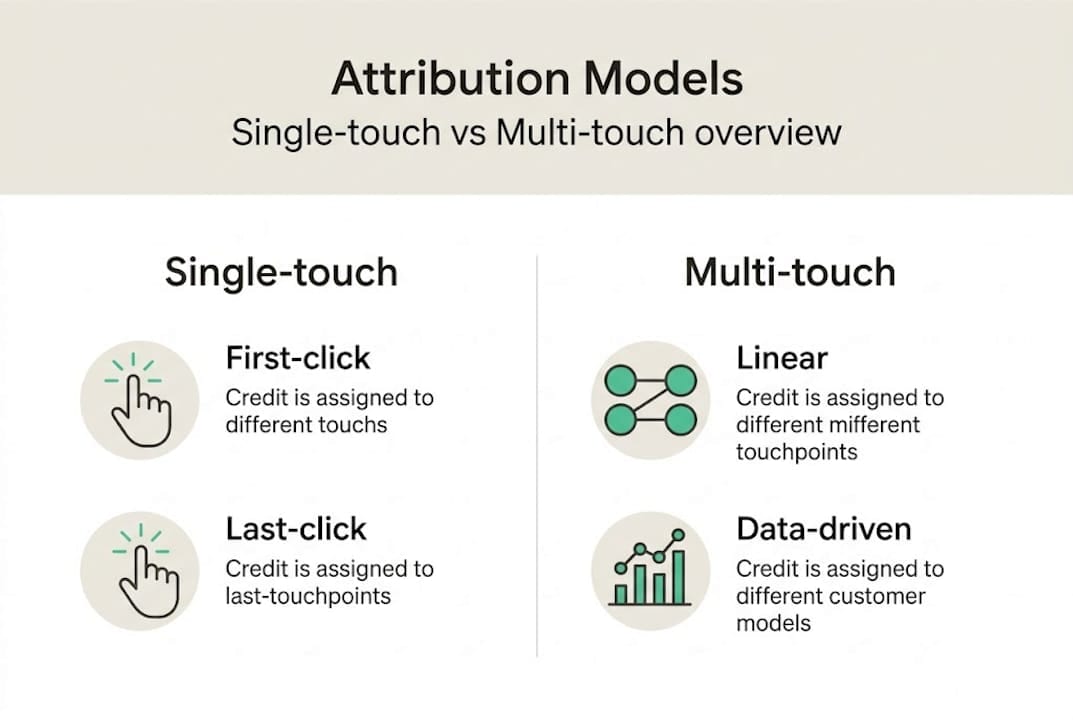
Single-touch models assign all credit to one interaction:
- First-click: Credits the very first touchpoint. Good for measuring brand awareness campaigns.
- Last-click: Credits the final touchpoint before conversion. Simple, but ignores everything that built the relationship.
Multi-touch models spread credit across the journey:
- Linear: Equal credit to every touchpoint. Fair, but doesn’t reflect actual influence.
- Time-decay: More credit to recent touchpoints. Works well for short sales cycles.
- Position-based (U-shaped): 40% to first and last touch, 20% split across the middle. Great for lead gen.
- W-shaped: Adds a third focal point (the lead creation event), useful for B2B pipelines.
Data-driven models use machine learning to assign credit based on actual statistical impact. GA4 uses data-driven attribution by default, making it the most accurate option when you have enough volume.
| Model | Logic | Best use case | Limitation |
|---|---|---|---|
| First-click | 100% to first touch | Awareness campaigns | Ignores conversion path |
| Last-click | 100% to last touch | Simple funnels | Ignores upper funnel |
| Linear | Equal split | Brand campaigns | No nuance |
| Time-decay | Recency bias | Short cycles | Undervalues early touch |
| Position-based | 40/20/40 split | Lead gen | Arbitrary weights |
| Data-driven | ML-based | Complex funnels | Needs high data volume |
The modeling mechanics reference confirms that single-touch, multi-touch, and algorithmic models each serve different analytical goals.

Pro Tip: Match your model to your sales cycle. Short, transactional cycles favor time-decay or last-click. Long, research-heavy journeys demand position-based or data-driven models. For ongoing optimizing attribution tracking, revisit your model choice every quarter.
The impact of privacy and cookieless tracking
Privacy regulation and the end of third-party cookies are rewriting the rules of attribution. If your model relies on cross-site cookie tracking, your data is already degrading. Safari has blocked third-party cookies since 2017, Firefox followed, and Chrome’s deprecation continues through 2026.
What does this mean for your attribution model? Less signal. More gaps. And a higher risk of crediting the wrong channels.
The good news is that solutions exist:
- First-party data: Collect directly from your users via login, email, and CRM integrations.
- Server-side tracking: Move tracking logic off the browser to preserve data fidelity. Explore server-side tracking strategies to understand how this protects your measurement.
- Consent Mode v2: Google’s framework that recovers 70 to 90% of lost data when users decline cookies by using behavioral modeling.
- Cookieless identifiers: Email hashing, first-party IDs, and contextual signals can fill gaps left by cookies.
For GA4’s data-driven attribution specifically, you need 300 to 400 monthly conversions per conversion action to generate reliable model outputs. Below that threshold, GA4 falls back to last-click, often without alerting you.
| Privacy challenge | Impact on attribution | Recovery strategy |
|---|---|---|
| Third-party cookie loss | Signal gaps across channels | First-party data + server-side |
| Consent rate drop | Modeled vs. observed data | Consent Mode v2 |
| Cross-device tracking | Fragmented user journeys | Login-based identity graphs |
| Ad blocker usage | Missing pixel fires | Server-side event collection |
Using privacy-first attribution guidance from Google helps teams understand which signals remain reliable in a consent-first environment.
Advanced consent mode recovers up to 90% of attribution data that would otherwise be lost when users decline cookie tracking. It’s not a perfect solution, but it’s currently the most practical one at scale.
Pro Tip: Validate modeled conversions with independent experiments like geo-based lift tests. If your modeled data consistently disagrees with experiment results, your baseline assumptions need revisiting. Also consider eliminating tracking cookies entirely where first-party alternatives already exist.
Evaluating models and overcoming common attribution challenges
Picking an attribution model is just the beginning. Keeping it calibrated is where most teams fall short. Attribution discrepancies are normal. Different platforms use different attribution windows, different conversion definitions, and different credit rules. Meta counts view-through conversions by default. Google counts click-through. That’s why the numbers never match.
Here’s how to approach model evaluation systematically:
- Define a shared conversion definition across all platforms before comparing numbers.
- Run models in parallel using the same data source to spot divergence without platform bias.
- Set consistent attribution windows across every channel (7-day click, 1-day view is a reasonable default).
- Triangulate with Marketing Mix Modeling (MMM) to validate channel contributions at an aggregate level.
- Test incrementality by running holdout experiments that measure true lift, not modeled credit.
As marketing attribution experts note, no single model is perfect. Running multiple models in parallel, combined with incrementality tests and MMM, gives you a far more defensible picture of marketing performance.
Common pitfalls to watch for:
- Over-reliance on platform attribution: Each ad platform overcredits itself. Use a neutral third-party analysis for an unbiased view.
- Ignoring view-through attribution: Not all conversions come from clicks. Ignoring impression-based credit undervalues display and video.
- Static model selection: Your sales cycle changes. Your model should too. Review quarterly.
- Skipping data quality checks: A broken pixel or misconfigured event ruins any model, regardless of sophistication.
Pro Tip: Use third-party attribution tools for unbiased channel comparison. Platform-native attribution is useful, but treat it as one data point, not the final answer. Pair it with proving marketing ROI frameworks that pull from multiple sources. For more detail on improving precision, see accurate ad attribution insights.
The goal isn’t a perfect model. It’s a defensible one that your team trusts and acts on consistently.
Why triangulation beats single-model attribution
Here’s the uncomfortable truth most attribution guides skip: the search for the perfect model is a distraction. Teams spend months debating first-touch versus last-touch, switching GA4 settings, and chasing marginal improvements, while the real problem is that they’re treating attribution as a fact when it’s actually an estimate.
Every model is a simplification of reality. The customer doesn’t care about your attribution window. They saw your ad, forgot about it, searched for a competitor, came back via email, and then converted. No single model captures that cleanly.
What experienced teams do instead is triangulate. They run model comparison strategies across multiple frameworks simultaneously, then look for agreement. When three models all point to the same channel as undervalued, that’s a signal worth acting on. When they disagree, that’s a signal to run an incrementality test before making budget decisions.
As attribution experts confirm, the combination of multi-model use, incrementality testing, and MMM produces far more reliable insights than any single model in isolation. The best attribution strategy isn’t about finding the one true model. It’s about building a system of evidence that reduces your margin of error over time.
Take your attribution modeling to the next level with Trackingplan
Getting your attribution models right requires clean, reliable tracking data at every step. Broken pixels, missing events, and schema mismatches silently corrupt your attribution results before they ever reach your models.

Trackingplan automatically monitors your entire analytics stack, alerting you in real time when tracking issues appear across your website, app, or server-side setup. Whether you’re managing digital analytics tools across multiple clients or auditing your own Martech stack, Trackingplan gives you the confidence that the data feeding your attribution models is accurate. See how Trackingplan works and stop letting silent tracking errors skew your channel decisions.
Frequently asked questions
What is the main purpose of attribution modeling?
Attribution modeling assigns credit to each marketing touchpoint, revealing how individual interactions contribute to conversions or leads. It helps marketers allocate budget based on actual channel performance.
How does cookieless tracking impact attribution accuracy?
The phaseout of third-party cookies reduces observable signal across channels, but first-party data strategies and consent mode recovery can recover up to 90% of lost attribution data through behavioral modeling.
Which attribution models are recommended in 2026?
Data-driven and multi-touch models are preferred, but experts recommend running multiple models simultaneously and validating results with MMM or incrementality tests rather than relying on any single model.
How many touchpoints does a typical conversion require?
B2C conversions require 6 to 11 touchpoints on average, while B2B conversions can involve 14 to 27 or more interactions before a purchase decision is made.
What are common pitfalls in attribution modeling?
Over-reliance on platform attribution models leads to biased results since each platform overcredits itself. Using only last-click and skipping incrementality testing are equally common mistakes that skew your insights.